
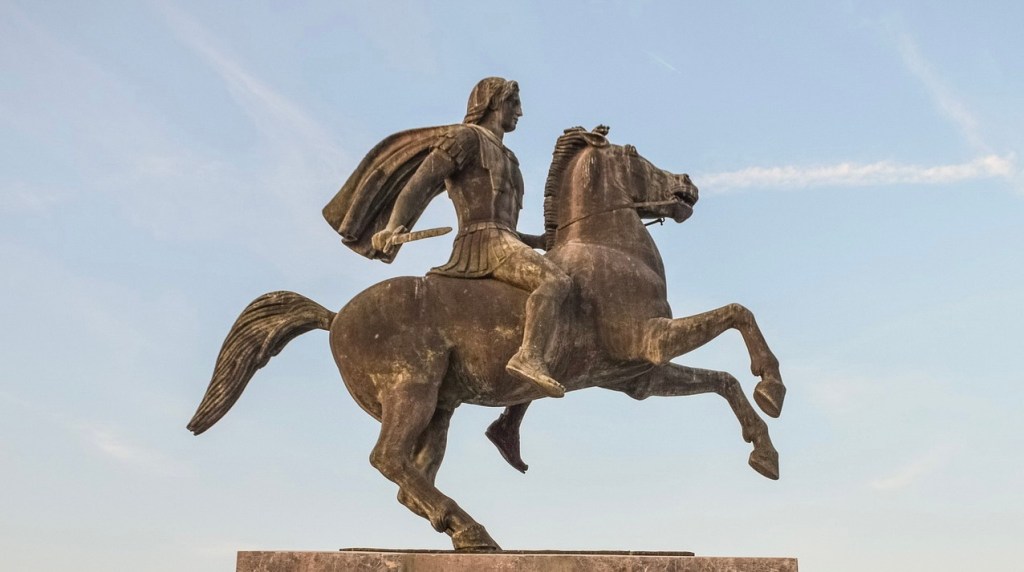
In the end, when it’s over, all that matters is what you’ve done
– Alexander the Great
Sounds easy for him to say. Alexander perhaps commands the weight of the epithet ‘great’ more comfortably than any in history. A sense of inevitability about the life and achievements of Alexander III of Macedon is often evident, as we see his inexorable string of victories laid out, the shadow of which casts to today.
Legends surrounding his early life may be an attempt to retrofit this perceived inevitability. Plutarch (400 or so years later) writes that, prior to the consummation of her marriage to Philip of Macedon, Alexander’s mother Olympias ‘dreamed that a thunderbolt fell upon her body, which kindled a great fire’. While the 21st century prescribes a trip to the sexual health clinic to remedy a burning sensation down there, Plutarch writes that Philip (spurred by numerous other visions) sought council among his diviners and the Delphic oracle.
We also hear that Zues himself in the form of a serpent fathered Alexander and, if for some strange reason this wasn’t factually correct, Alexander could claim descendancy from Heracles on his paternal side. On his mother’s side, none other than Achilles occupied the upper branches of the family tree. Safe to say, then, that the young Macedonian prince had divine lineage covered.
The weight of expectation seems to have driven Alexander to live up to his lineage, this is especially evident in his idolisation and emulation of Achilles. We hear from the biographer Plutarch of his annoyance at the successes of his father Philip. He protested that his inheritance of the kingdom would be so neatly packaged and devoid of opportunity for glory that he would be forced into a life of quiet maintenance, resulting in a legacy hardly befitting of the family history.
So after inheriting a united Greece, and an army with tickets eastward already booked under his father, Alexander set out in 334 BC across the Dardanelles to forge his legacy and take on the biggest power of the day: the Achaemenid Empire.
We don’t need to delve too far into the following, but over the next 10 years Alexander enacted his conquest across the eastern Mediterranean, Egypt, the Middle East, and parts of Asia- ending as far as modern-day Pakistan. Darius III, who would be the last king in the Achaemenid dynasty which included Cyrus the great and Xerxes, endured a rolling thunder of losses across his lands in the initial years.
In ‘Monopoly: First Persian Empire edition’ Darius quickly went from the dominant player to losing a foothold in the game as Alexander swept up the properties. Alexander even extended the board through founding multiple new cities along the way. He also did what we all sometimes find ourselves wishing to do in Monopoly: have our opponent killed.
Alexander’s achievements have been much venerated throughout history. He became the exemplary figure for an expansionist Rome, and his action hero looks and charismatic personality make him a founding ‘too fast to live, too young to die’ star in history. However, the legacy of history’s most eminent conqueror (sorry William) has been wrestled with in more recent times.
As attitudes towards warrior-kings and dictatorial one-man rule have become somewhat less positive of late, the legacy of Alexander has been prodded and interrogated. Is he the archetypal western hero, apex of leadership and virtue that so many paint him as? Or is he simply a tyrant whose military prowess only facilitated greater suffering, feeding an insatiable appetite for imperialism?
The answer is probably a bit of both. While he is indeed great in the historical sense of the word, the jury will forever be out on if he was good.
Alexander wanted to matter. To leave tangible marks of himself and his actions on the world. To this, he succeeded. He laid the foundations for the spread of Greek culture to such an extent that he ushered in a new age: the Hellenistic period.
However, none of us plan to die at 33. Therefore, in one sense, he left behind a tattered legacy. With no immediate heir, the maintenance of his nascent empire was left to his generals. This led to a (some say inevitable) surge of civil war sweeping his new lands, and subsequent disintegration of the empire into multiple seats of power.
Alexander’s legacy is therefore possibly cemented positively by his untimely end; meaning that his departure after winning all the glory prevented him from the ensuing struggle to maintain his vast new area of jurisdiction. He is in this way, rightly or wrongly, remembered exactly for what he wanted to be.
How many of us will be able to say the same as for Alexander? I don’t mean as being a literal world-beater, but being able to say we achieved our ascribed expectations in life. For, if we distil his life down, this is what he did.
We, like Alexander, naturally view ourselves as the main character in our own stories and, as the protagonist has to do something of importance, we often experience the pressure of writing a good one. I’ve no doubt that Alexander experienced great concern and anxiety in his desire to produce the legacy he envisioned. A legacy that is the summation of his actions and, by his own words, all that mattered to him.
While many of us toss aside the pressure to produce a legacy, some of us do not. For these people, Alexander included, their meaning and motivation in life is found in and hinged by the eventual creation of a legacy they are happy to leave the world. It really isn’t hard, if you wish to form a legacy of your own, to emulate the greats. This is because it isn’t the outputs that matter, it is what you put in. While we shouldn’t want to match the physical marks Alexander made in life, we can certainly mirror the intangible thought processes and emotional state that was the driving force to producing a legacy of such renown.
This is where Selfish History comes in, as we find the parts of Alexander’s colossal life and legacy that we are genuinely able to apply to our own existence. Yes, we almost certainly can’t produce a legacy of equal weight – however we can extract what led to the formation of Alexander’s ‘greatness’ and use this in our personal legacy planning if we wish.
On this smaller scale, we can make a name for ourselves in our own personal kingdoms through strong leadership, and resolute loyalty to those we hold in high regard and surround ourselves with. We can even go one better than Alexander through (not to sound like I’m parroting a SunLife ad here) making concrete plans for our passing in order to prevent the gifting of a legacy burdened with debt and untied knots.
If you want your name to live on as long as possible then a good rule of thumb is to use it. Alexander gave his name to Alexandria, Augustus gave himself a whole month in August, and Walt Disney has ensured his legacy is forever twinned with that of his namesake. Just be careful if you, like Italian chef Caesar Cardini, share a name with a historical figure. Otherwise your culinary excellence and all-timer salad skills shall forever be wrongly credited to a 2100 year old dictator.
Actionable steps here is to tie your name to a foundation or charity, or, if you have one, go the Disney route and embody your business. As we live in an age that affords us to do so, leave a digital footprint in the form of a blog, lively social media page, or educational YouTube channel. (Just remember to remove THAT embarrassing post- you know the one.)
You may be comforted to think that, as long as outputs such as the above are active, people can continue to learn from and interact with your legacy for a long time yet (some still dedicate entire careers to learning from Alexander’s actions and wisdom). If it helps you, like Alexander, to sign off on a life well-lived by putting that very signature on long-lasting entities, then certainly do so- and make them as positive as possible.
However, even if we do forge a legacy of magnitude enough to, for example, have an eponymous movie made long after our deaths, there is no guarantee of it being any good. Alexander (2004) is an unfortunate example, and I am sure the man himself would be very keen for a comprehensive remake with himself at the helm. The very fact he can’t, demonstrates the falsity of feeling in control of how we are remembered, although at least he is exactly that. Remembered.
***
Selfish History’s book recommendation:
Philip and Alexander: Kings and Conquerors by Adrian Goldsworthy
A topic I have lightly touched on here, this book paints the life and legacy of Alexander as a continuation of, and even reliant upon, the legacy of his father Philip. Philip employed impressive diplomatic and military skill to conquer Greece, allowing Alexander to look eastward with both eyes. We also read that Alexander’s infantry formation, the devastating Macedonian phalanx bristling with 6 metre-long pikes,, was the brainchild of his father and the army itself was nurtured to being under Philip’s Kingship. The book doesn’t take away from the ‘greatness’ of Alexander, it adds all-important context and tells the story of both men.

 Selfish History
Leave a comment