
How some of history’s smallest legacies have been elevated to great importance
When we go to the cinema and the credits roll, there is no shortage of methods in play to keep us in our seats and our eyes on the screen. Once the big names are spotlighted, we are treated to behind the scenes content and goofs as the rest of the crew have their name steadily float upwards into the ceiling.
Sometimes, even, all the characters have gathered to do a funny little dance for us. Part of the reason for this is to give everyone involved their moment in the sun; so that someone might glance away from the silly jig the villain is doing and nod to the work of Camera Support Equipment Technician 6- good job.
When I’m looking at the credits, I like to look at the unnamed character’s descriptions- think ‘pub man 3’ or ‘tall woman’. On closer inspection, these roles are still vitally important to the movement of the plot. At the very least, we need these ‘normals’ so it is more pronounced how amazing our protagonists are.
However I find this does a disservice to the extras of film and I am inclined to say the same of history’s smallest contributors also.
While most leave nothing, and a few leave vast legacies- some lie somewhere on the edge. For these individuals we have tiny shreds of evidence that say ‘I was here’, resulting in the narrowest escape from eternity in oblivion. They are not quite remembered, but also not entirely forgotten. I am going to call these ‘liminal legacies’.
We know very little of these people, sometimes not even their names, and the fact we know anything at all is usually down to cosmic luck. But, just like in film, they deserve their place in the credits.
It is often the case that these small, mundane, insights into a singular life elevate those with a liminal legacy from limbo to great heights equal to the biggest names of their day. These liminal legacies can also be used to address some of our questions about our central topic in this series.
While we started with the totemic Alexander the Great, these ‘extras’ lend themselves nicely to our dissection of legacy this series. Here we will meet three of these liminal-legacy-holders, and finish up by taking our Selfish History lens to them.
At the very least, I hope you don’t require me to be dancing on your screen in order to retain your interest while reading about these people who have a small, but profound, story to tell.
Kushim: admin work that really did take 5000 years (to be found)
Over 5000 years ago Kushim worked as an administrator in a barley warehouse in Uruk (now Iraq). As did many others I’m sure, but we know Kushim did – and that makes him special.
Not special in the sense that he steered early civilization, was privy to the lives of kings, or did anything particularly of note in life (that we know of). No, he is special because, against all odds, he made it. He made it here, all the way to the 21st Century and to the calm shores of Selfish History. (He also, much more impressively, made it in the Guinness World Records: ‘first surviving personal name’.)
We possess eighteen tablets containing his name in a pictographic writing system that is something like cuneiform: an early form of writing using wedge-shaped characters . These tablets, then, are ‘written’ in an archaic version of a script which is, in itself, archaic.
Pause a moment. Imagine if eighteen of your work emails were plucked at random and survived to the year 7100. Not just survived, but studied at great length and treated as tantalising insights into humanity in the 21st Century. This is Kushim’s reality, and who knows what he would think about it.
Khushim’s tablets reveal records of the incomings and outgoings of malt and barley, destined to be made into beer, in his warehouse. They also reveal that Khushim’s world, aside from reflecting the eternal appreciation for a crisp pint, was one of growing economic complexity and burgeoning inter-city trade, as well as one in which education and communication was becoming an increasing necessity. Khushim has unwittingly become a key figure in his entire civilisation, outlasting many of the great names of his day for which we have no historical record.
Khushim’s liminal legacy is one which as much as any other highlights the lack of control we have over if, and then how, we are remembered. It is the very fact he left such a small mark of his existence 5000 years ago that has invited such discussion and hullabaloo around his likely humdrum, ordinary, life. Also notable in the content of Khushim’s tablets is a considerable amount of mathematical errors, proving our mistakes really can haunt our legacy and come to define us.
Sorry teacher, the sands of time ate my homework
Room 25 of the National Gallery in London houses two masterful pieces by Cologne’s leading painter in the early renaissance period. We have (we think) around 25 of the Master’s paintings, many of which are on display in prestigious museums across the world, and all which showcase great skill and demonstrate a distinctive style.
There’s just one problem: we have no idea who this person is. Named after one of their works, the life of our ‘Master of the Saint Bartholomew Altarpiece’ is one scholars have tried to piece together using this artistic legacy as the starting point. We will probably never know any real detail of the Master’s life- not even their name.
The same cannot be said for a seven-year-old Russian boy from 13th Century Novgorod. While his drawings, etched in birch bark, are more destined for the family fridge than the National Gallery, their creator left their name- Onfim.
Onfim’s 17 items, a mixture of drawings and homework, depict scenes of knightly combat and fantastical monsters. They are endearing proof of the presence of childlike imagination and daydreaming through the ages, as Onfim labels himself as the holy combatant seeking support from above. In places his alphabet practice tails off into one of these scenarios: a relatable and very human manifestation of his thought process and attention span, that brings him right into the classrooms of today.
Onfim has been celebrated as the eternal child. We have a small glimpse of his early life and he will forever be anchored to these etchings that, among so many billions of similar items lost to time, have survived for us. He even has a statue in Velikiy Novogrod today, a physical manifestation of the boy that will forever be realising his young mind’s exciting adventures and fantasies.
Contrasted together, the Master of the Altarpiece and Onfim raise some interesting questions about legacy. One assumes that our Master consciously left their pieces unsigned, thus we can gather that they cared more for the preservation of the art than the artist. As names hold much weight in the world of art, leaving your work unsigned can be a way to ensure that, if it escapes being lost to time, the art is remembered for the quality and its own merits.
Onfim on the other hand made sure to put his name against his achievements. He, deliberately or not, emulates our advice in part one to those who wish to be remembered like Alexander the Great: stick your name on things you are proud of.
It is interesting just how far knowing someone’s name humanises them and brings our mental picture of them into focus. This is why we see unidentified remains given (often amusingly anachronistic) names- ‘oh, that pile of assorted neolithic bones over there? Yep, that’s Jayden’.
Onfim has become an unlikely celebrated individual not just because of the art, but because we can relate and feel close to the artist. Many of us here will get more excited over the etchings of a seven-year-old than a renaissance master, because we love to form a story and attach a personality to what we see and discover in history. A name can lift the veil of obscurity and invite us to start filling in the gaps.
The Unknown Warrior: a liminal legacy made literally monumental
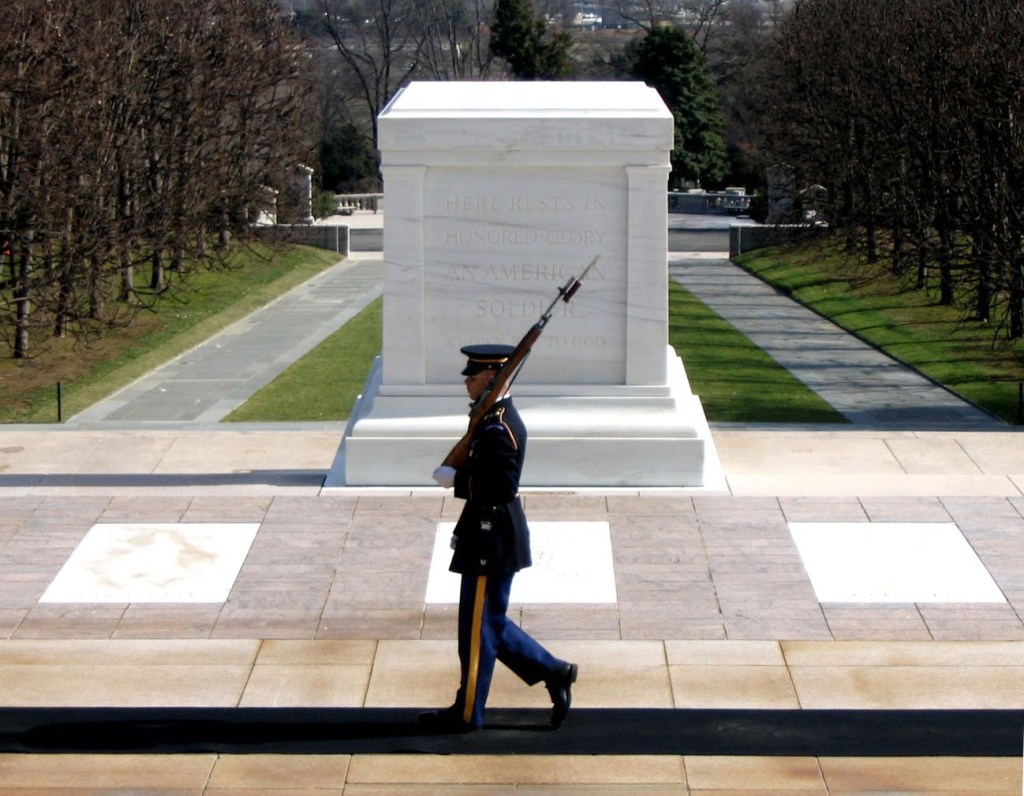
Sometimes however it is the lack of name which is centrally important to an individual or collective legacy. Few unnamed people in history have come to represent more than the Unknown Warrior.
While I have bemoaned the practice of amalgamating millions of individual legacies, in the aim of forming impersonal teachings from major historical periods and events (for example the legacy of the British Empire), the Unknown Warrior (or Unknown Soldier in the US) both subscribes to and rejects this trend.
The UK’s Tomb of the Unknown Warrior in Westminster Abbey in some ways is an evolved version of many a makeshift burial during the First World War of 1914-1918. It was one such grave on the Western Front, marked ‘An Unknown British Soldier’ that caught the eye of army chaplain David Railton and gave him the idea to apply that anonymous remembrance to all fallen warriors.
Following universal support and approval from the public and monarchy alike, a randomly selected and unidentified individual was given a state funeral and interred in 1920. One unknown soldier suddenly came to represent something far larger, as they were pulled both from the ground and from a state of impending oblivion. In the aim of the Tomb, the latter applied to all across the empire lost in the Great War.
It is proof that even if their names and stories are forgotten, what each and every individual gave deserves to be remembered. This is an all-encompassing legacy for those who didn’t leave one. It is simultaneously every fallen warrior and one; a liminal legacy of an unknown person who ensures that hundreds of thousands aren’t quite forgotten themselves.
The End?
Next time you send a letter or an email, or indeed add anything tangible to this world, it is possible for that tiny part of your life to define your entire existence and legacy. Every minor output and miniscule dent we put on this planet is a lottery ticket. A chance, however infinitesimally small, that we will be remembered, celebrated, and studied no matter how seemingly average our lives might seem to us.
This is, unfortunately for some, a lottery we cannot opt out of. For those of us who don’t care to leave a legacy, and wish not to be studied in future, this only affirms the choice to live without attendance to your rememberance. You also don’t have to put your name to what you do, even if it is masterful in the true sense of the word.
And for those of us who would like to live on in the minds of many, and perhaps fear being lost to the vaults of time? Know you are in the draw and find comfort in the fact that, even in 5000 years, someone could rediscover your existence and put your name into the history books.
I’ll finish with a short quote that can be applied to our above individuals and our wider idea of liminal legacies:
Some men are born posthumously
– Friedrich Nietzsche
***
Selfish History’s book recommendation:
Weavers, Scribes, and Kings: A New History of the Ancient Near East by Amanda H. Podany.
I first read of Kushim in this book which, as the name suggests, offers up many liminal legacies of the Near East. Fascinating insights abound as Podany skillfully sits us down with these ancient people, extracting personal history from bricks, records, and other recovered fragments of life. It is a voluminous book with a comprehensive cast of characters in the appendix. If my idea of liminal legacies interests you, I am confident this will be a great read for you!

 Selfish History
Leave a comment