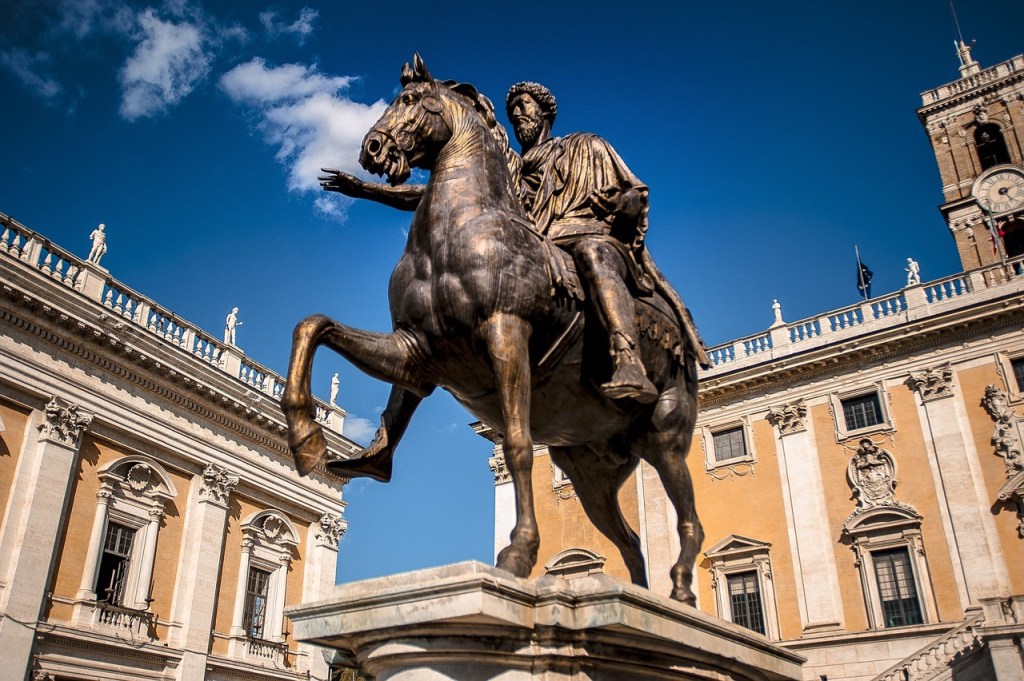
As I write this, 8/50 of Amazon’s best sellers in philosophy concern Stoicism. This school of philosophical thought was founded in Athens, well over 2000 years ago, by a man named Zeno. Four of these books are modern examples, making use of the foundational texts for today’s audience. The rest (highest placement being #3) are various editions of one book: Marcus Aurelius’s Meditations.
Meditations has become a work of near-biblical proportion. Studied now for centuries, Marcus’s writings have more recently been found in the hands of world leaders such as Theodore Roosevelt and Bill Clinton. His words have also influenced the lives of athletes, actors, business gurus, and any who wish to explore Stoic thinking. (The slim but profound volume sits on my shelf next to Seneca’s Letters from a Stoic, a work deserving to be alongside Marcus’s on the charts in the humble opinion of Selfish History.)
Meditations has, of course, recently enjoyed an explosion of popularity alongside the wider cultural resurgence of Stoicism. This upsurge of interest in Stoic thought has been attributed to many factors, although I can identify my two most likely culprits.
The first is the search for meaning in a world where religion is becoming less subscribed and adhered to. Those who have unmoored from religious thought find themselves adrift looking to fill a theism-shaped hole. Stoicism, with its practicable teachings and emphasis on virtue, offers the perfect scaffold with which to build a new life.
The second concerns the fact, if you hadn’t noticed, it’s absolute chaos out there. World news is a veritable buffet of global crises from climate change and conflict to natural disasters and viruses. For those of us rendered sickened and immobile by this all-you-can-eat exposure to suffering, the hand of Stoicism takes the plate away. There is something particularly comforting in being reminded of what we can and can’t control, and to toss aside worry for the latter. This central aspect of Stoicism feels especially applicable today, and therefore has a magnetising force.
Anyhow, Marcus- as well as being symbolic of Rome’s Golden Age- has become a figure synonymous with the school of thought he so diligently attended in his writings. He was also officially deified after his death and, in an achievement of even greater magnitude, is a Sunday Times Bestseller. One can argue with some merit that for all he left us, his Meditations is probably his best contribution to history- cheers Marcus.
Except, no. Meditations was Marcus’s personal diary; his original title is something like ‘To Himself’. In fact, it was never intended for us to read at all. This means that the work was never meant to define Marcus’s legacy, its preservation through history a result of placing public good above personal privacy.
Thinking about Marcus’ legacy, if his jottings didn’t survive, we see a stark difference in this intended legacy vs his actual legacy we have today. It is my belief that if his writings weren’t with us Marcus’s legacy would be tainted a great deal more by what he did leave the world: his son, Commodus, as his successor.
In the book of ‘bad’ Roman emperors, Commodus occupies his fair share of pages. His accession in 180 as sole-emperor (he had already co-ruled with his father for three years) marks the end of the Pax Romana, the period of 200 years wherein Rome enjoyed relative peace, prosperity and stability. Commodus also goes one better and puts his hand up, to some historians, as commencing the decline of the Roman Empire as a whole.
Marcus surrounded Commodus with the best tutors of the day. Efforts to immerse his son in his philosophical worldview no doubt abounded, however none of the father’s wise words seemed to pierce Commodus’s affinity for hedonism. Commodus, now given the keys to the kingdom, almost bankrupted the Empire and was decidedly more interested in his career as a gladiator than an emperor.
There is no shortage of gruesome detail regarding Commodus’s reign. Roman historian Cassius Dio, a senator during Commodus’s rule, puts it succinctly and bluntly for us: ‘Commodus was guilty of many unseemly deeds, and killed a great many people’. One can picture Dio here as one of the talking heads on Netflix’s six-part docudrama on Commodus: Reign of Blood.
Some believe that our children are our greatest legacy. That the most important job in our lives is to instil our love and values in our offspring. In this view of legacy, Mr Aurelius failed quite spectacularly. Marcus’s immediate legacy was unleashing his son on his beloved Rome. A son who Marcus, in all his wisdom, would’ve known was unfit to rule. The painful alternative is that parental love blinded Marcus to the realities of his son’s character and virtue (or lack thereof).
Stoicism, and therefore likely Marcus, however refutes the notion that the parent is responsible for the actions of the child. Marcus in this way serves as proof that you can bring a horse to water, but not make it drink. Moreover, the Stoic view of legacy is one which diminishes its importance entirely.
Stoics see legacy as a fame we cannot experience ourselves. This posthumous fame, writes Marcus, is a flame which will soon extinguish once those who remember us die too. Stoics further argue our legacy isn’t ours at all due to the fact we can’t experience it ourselves- it is one of those external parts of life we must accept is out of our control. Marcus, then, would probably accept the dissemination of his personal notes as one such uncontrollable externality.
Marcus’s parenting struggles do humanise the much-revered man and remind us that no one in history is immune to life’s big challenges. Marcus and Commodus are also a shining example that virtue is not hereditary. Overall, zooming out past the blotch of Commodus, Marcus’s legacy is certainly a net positive on the world even if he never intended it to be, or cared about it at all.
You might think that Marcus hides behind his detachment from legacy, and uses the Stoic view of the parent not holding responsibility for the child as a bit of a coward’s way out in dealing with Commodus. You are very much entitled to do so; Marcus’s son was a real piece of work. I believe there will always be a camp that reminds us, despite all his greatness and achievements, Marcus didn’t succeed at what is (for them) one of the most important parts of life.
By his own belief, Marcus’s legacy isn’t his. It’s ours to interrogate, enjoy, curse, and experience- and that is exactly what we are doing. These very words are doing precisely that. Marcus however, in line with his Stoic philosophy, in all likelihood died believing he had lived a life stuffed with as much virtue as he could personally muster. That is by any definition a life well lived.
If you want to emulate him in this respect, adhere to your values and live in accordance with nature. Gift yourself a fulfilling life and die knowing you did some good.
A legacy is just an insignificant byproduct of that.
Some final words from the man himself:
Human life.
Duration: momentary. Nature: changeable. Perception: dim. Condition of Body: decaying. Soul: spinning around. Fortune: unpredictable. Lasting Fame: uncertain.
To put it shortly: The body and its parts are a river, the soul a dream and mist, life is warfare and a journey far from home, lasting reputation is oblivion.
Then what can guide us?
Only philosophy.
[…]
– Marcus Aurelius Meditations 2.17
***
Selfish History’s book recommendation:
Marcus Aurelius: The Stoic Emperor by Donald J. Robertson
This personal biography of Marcus’s life tracks his story while weaving his philosophy throughout in a really digestible way. There is even reference to Commodus and Marcus’s legacy at the end…

 Selfish History
Leave a comment