
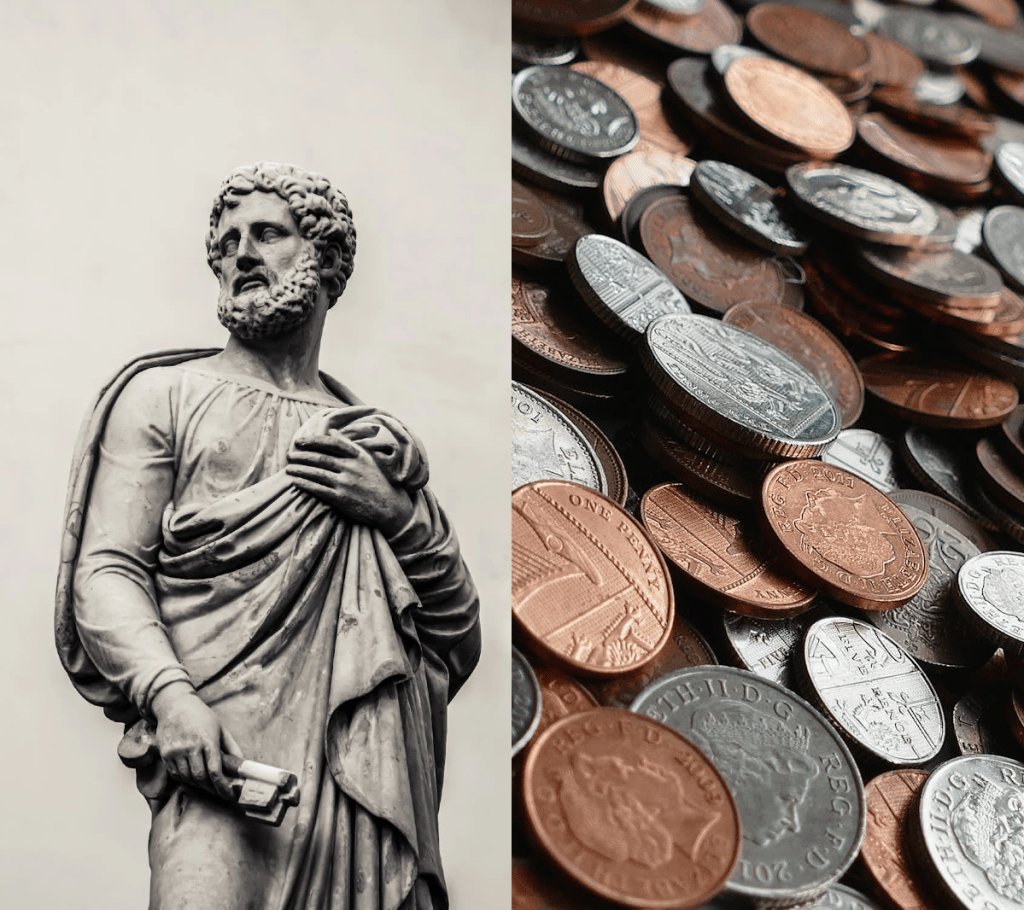
Money is an enabler of dual potential. To some, possession of it empowers them to lead a life punctuated by positive experiences, generosity, and healthy societal involvement. For others, money, or the pursuit of it, is the ear-whispering force enabling harmful habits such as addiction and greed – truncating the path to destitution, or worse.
Our personal relationship with money begins to crystallise at a very early age; it materialises as an angelic or devilish enabler from the age of seven. This only provides further uplift to eyebrows when paired with the distinct lack of financial literacy within curricula worldwide, including the UK and USA. The unfortunate result is that, for many who suffer later in life, a damaging relationship with money can be nipped in the bud from a formative age.
Indeed, few things are as capable of a contrast of outcomes than possession of money. The root of all evil can also be a route to wealth, both monetary and, perhaps more importantly, what many define as true wealth (knowledge, contentment, purpose ect).
To this end – guiding us in the right direction – comes an unlikely candidate: philosophy. Philosophy and economics (or personal wealth) are viewed as in a dichotomous relationship akin to war vs peace or, especially when their respective proponents debate, cats vs dogs. In all fairness, few can imagine famed Cynic Diogenes – who lived in a barrel – to advocate for filling your coffers.
Pursuance of monetary wealth is seen as fundamentally at odds with striving for the moderation and virtue – essentially a ‘good life’ – associated with much philosophical teaching. However the value of building bridges between these two historically disparate factions is now being recognised.
For example, students can now study ‘Philosophy and Economics’ at a number of UK universities. On a more personal level, which we strive to seek at Selfish History, ‘financial philosophy’ occupies a greater chunk of personal finance discourse than ever before.
Forming your own philosophical view of money and underlining its importance in your life is an important step in the cultivation of wealth or otherwise. So, let’s visit a few philosophers to understand where money has been vaunted and diminished, praised and condemned, valued and disparaged.
***
The growing importance of money in burgeoning early societies precipitates its blooming into becoming central to much of human life. It is a societal shift thousands of years ago pregnant with change, controversy and, to some, a philosophical Antichrist of sorts.
This is reflected across much of the founding teachings in western philosophy, although there are some insights as to the importance of money and how a healthy relationship can improve one’s life.
Plato the Soul Man
In Plato’s (c. 427 – 348) Republic, a grand Socratic dialogue and eminent work of western philosophy, we grapple throughout with the central topic of justice. Here, the nature of true justice within an idealised political society is laid out for us. And, as it happens, the very same structure upholding political justice can be applied to our personal balance – our soul.
Plato identifies three aspects of the soul which are parallel to his three societal classes. These are: the rational soul, pertaining to truth and wisdom; the spirited soul, which upholds the convictions of the former; and, most related to our discussion, the appetitive soul concerning our desires which yearns, above all, for money.
Plato provides a clear hierarchy within this tripartite soul. The rational leads, the spirited bolsters and supports, and the appetitive is to obey and be kept in check. Simply, Plato places the virtue, truth, and knowledge associated with the rational soul as more important than the seeking of honour and wealth among the respective lower forms.
It is here that we uncover Plato’s (un)importance placed on monetary gain. Those who value the realisation of their desires and seek wealth over virtue exhibit their appetitive soul as a dog released from the leash, gnawing at the share given to achieving our true life goals.
Disobedience in our appetitive soul therefore causes imbalance, drawing us away from what Plato outlines as the ideal system. Plato asks you not to place pride and honour above truth and virtue, and to place wealth below the lot. That said, if our entire being is to serve our rational aspect, then our desires – our money – must have a role to play.
Firstly comes moderation. It is somewhat of a buzzword in Socratic (and therefore western) philosophy but it is reflected here importantly all the same. Reigning in our desire for pleasure and wealth is an important practice in focusing more effort on embodying true goodness and virtue (something we all probably know deep down anyway).
Moreover, Plato’s hierarchical structure asks us to use our appetitive to fulfil and obey the rational and achieve a balanced, good, life. So where can it come in as a useful teammate?
The truth is, money can be an enabler of much virtue. Most obviously, knowledge can be purchased, or at least accessed, with money through books, educational courses, informative media, and qualifications. Here our money is put to good use and our desire for it translated into obtaining wisdom on the other end.
Making charitable donations and supporting causes we believe in also interlinks money with virtue, using it as a force for good and justice. ‘No wealth’, writes Plato, ‘can ever make a bad man at peace with himself’. This is true should the pursuance of virtue be nowhere in our monthly budget, although money can indeed be used for both our individual and collective good. We can here reconcile virtue and wealth by putting the latter in service, as per Plato’s structuring of the soul.
Aristotle on Spending Wisely
This notion of putting our money to good use (and so avoiding the maligned status of wealth-seekers in philosophy) is a nice discussional ticket to a couple of decades later, arriving at Aristotle (384–322 BC): pupil of Plato.
Aristotle is in many ways a spiritual successor of his revered master, although his philosophy can be considered more employable and practical than Plato’s propensity for abstract thinking and his more theoretical approach. To that, Aristotle offers an additional angle on the role of money in life.
Aristotle firmly believes (literally) everything has a purpose – known as its telos. The function (telos) of money, to Aristotle, is to be a medium of exchange. To facilitate transactions. Once said transaction is complete, the money has fulfilled its purpose.
When wealth begins to be gathered merely for the sake of more wealth, we move away from the natural telos of money and into a realm Aristotle is most critical of. This is especially true for those who ‘breed’ money through demanding interest; don’t get Aristotle started on usury.
Aristotle therefore sees no true reason in cultivating wealth, as the money fulfils no purpose if not being employed in relation to its telos. In other words, it’s all a bit pointless: hoarding presents no improved avenue to achieving holistic happiness and wellbeing – Aristotle’s chosen ‘meaning of life’.
Think, then, of money and wealth as a means to an end. They are to be used to the desired end of a satisfactory life, defined by happiness and meaningfulness. Consider Aristotle’s central view of talos in his following line: ‘Being wealthy consists in using things rather than in possessing them; for it is the activity and use of such things that makes up wealth’.
To Aristotle a comfortable existence is still well-earned, and the fruits of labour are virtuously spent on household management and facilitation of leisure upon completion. Excessive wealth however is not of use to society or ourselves and certainly not conductive, when unspent, to a life well-lived.
Similarly to Plato, an investment in rich experiences, education, or societal benefit is a good one. One that serves the fulfilment of a life in accordance with philosophy, employing money to achieve this purpose – our own telos.
‘Wealth is for the sake of life, not life for the sake of wealth’
Seneca and Epictetus: Rich Stoic Poor Stoic
Lucius Annaeus Seneca
Seneca (4 BC – AD 65) was something like the Jeff Bezos or Elon Musk of his day. His personal wealth was many multitudes greater than that even of his patrican ‘peers’, bulwarked thanks to his birth into a wealthy family.
Orator, advisor, philosopher, senator, tragedian – Seneca’s CV unfurls like a stately scroll (or dropped tube of toilet paper). Being such a powerful and wealthy individual in the sphere of some particularly autocratically-minded emperors, Seneca naturally invited some abrasion with Rome’s ‘first man’.
Firstly, Caligula ordered him killed before settling for the lesser punishment of banishment. Seneca’s return to Rome under Claudius’ rule some time later resulted in yet another banishment under charges of adultery. He was eventually invited back to tutor Claudius’ adopted son and heir: Nero.
In an interesting parallel with the later Marcus Aurelius’ parenting woes, the Stoic’s tutelage of Nero appears not to have had a great effect on the hedonistic emperor. Years later, the now recluse Seneca was accused of contributing to a plan to assassinate his former pupil.
‘Ah great, another banishment’ he thought. But no, Seneca was ordered to kill himself and summarily did so with famous acquiesce and as much dignity as can be mustered.
Since his death Seneca’s monetary legacy, while hefty, is outweighed by his philosophical one. You may expect conversations on wealth and money to be conveniently omitted from Seneca’s writings, due to his position being somewhat at odds with the traditional picture of the austere philosopher.
However, he nonetheless voiced his thoughts on such topics. (Aristotle would certainly label Seneca unqualified to lecture on money as Seneca’s wealth was perpetuated by high-interest lending which is, as we know, a pet peeve of his.)
Seneca likes to remind us he is not defined or controlled by his wealth. Do not love wealth, he asserted, but do not shun it or reject it either. Instead, and to some extent placating our theoretical Aristotle, Seneca believed wealth to be used in exhibiting and attaining the Stoic’s core virtues: wisdom, temperance, justice, and courage.
With Platonist brushstrokes, Seneca writes that fortune is to be used in service of ourselves, instead of the alternative in which we are slaves to our money. Among his fellow patricians, Seneca saw money control every detail of their lives. He writes that these people ‘have riches just as we say that we have a fever, when really the fever has us.’
Seneca’s insistence as to the dangers of consumerism and the unhealthy draw of fortune have naturally invited criticisms around hypocrisy. We can perhaps explain such a contradiction by remembering Seneca was on his own philosophical journey, and so these are wary self-reminders. In possessing great wealth, Seneca was eye-level with the dangers he warned of, and so seems to have placed greater importance on these in his personal philosophy.
For those of us fortunate enough to possess ample wealth, and maybe concerned as to its potential detrimental effect, Seneca could be a useful example to consult. He was both intent on his philosophy and keenly aware of the dangers of his fortune in living up to his Stoic virtues.
A hypocrite to some, he didn’t just theorise the noble or uncaring attitude to possessing great wealth so common in philosophy, he was challenged to embody it everyday – undoubtedly the more difficult task.
Epictetus
Unlike Seneca, Epictetus (c. 50 – c. 135 AD) was not a man greatly familiar with wealth or worldly possessions. Born into slavery, he assiduously studied Stoic philosophy in Rome when not in service to his master Epaphroditus: a former slave himself and secretary to Nero.
In a post-Nero Rome, Epictetus gained his freedom before being banished by Domitian (who saw philosophers as holding too much control over public sentiment) some years later. And so Epictetus landed in Greece and founded his own school based on Stoic teachings.
When it comes to money, Epictetus and Seneca are largely agreed despite their contrasting backgrounds. Through Epictetus, we can build on the Stoic doctrine previously discussed.
In the vein of not being enslaved to obtaining and nursing wealth, the stoics saw judgement as the decider to all we experience. For money, this means it isn’t the coin or paper itself which is inherently good or bad (it is, after all, a scrap of metal), but our views and opinions imposed that decide which.
Just as money lacks intrinsic value economically speaking, so too, say the Stoics, does it lack emotional value until we place our judgement on it. It is a useful way to frame that money is merely a construction. From Epictetus’ Discourses: ‘What decides whether a sum of money is good? The money is not going to tell you[…]’
This means we have a great deal more control over money’s effect on ourselves and our relationship with it. Claiming this control is key to being on the right side of the divide. Epictetus agrees: ‘No man is free who is not master of himself’.
We, like Epictetus’s unfortunate birth into slavery, cannot control our economic circumstances or the fluctuations of the markets and nor should we fruitlessly seek to. Instead, we accept what we can control: our opinion of money itself.
It refutes Aristotle as, in a way, we decide upon the telos of money ourselves. However, a reminder of what we can and can’t control is a useful practice for many, and central to Stoics.
***
Seneca and Epictetus are rather different individuals, joined by their subscription to Stoic thought but separated by their personal wealth. It makes their strikingly similar view on money all the more profound as they come from two opposite ends of the economic spectrum.
Here are two quotes sporting very similar sentiments, from men whose worldly possessions and monetary wealth varied greatly (note that Seneca’s quote came first):
It is not the man who has too little, but the man who craves more, that is poor
– Seneca
Wealth consists not in having great possessions, but in having few wants
– Epictetus.
Stoics view wealth as but one way to embody central virtues and as a tool used in enriching your wider community. It is, however, capable of becoming a powerful vice and turning the owner away from a virtuous life. It is not the affluence itself that leads you down one path or the other, but the opinion you place upon it, informing your actions.
As shown by Seneca and Epictetus, steadfast loyalty to your view of wealth is to be unchanged by the levels of which you possess throughout life. Philosophy is to remain constant despite the volatile troughs and peaks of net-worth, perhaps especially in those peaking periods when the dangers become truly in reach.
Mission Successful?
The above philosophers are of course fairly unanimous in warning readers of the many perils and foibles associated with wealth and money. In this way we support the general understanding that inviting an investment banker and a philosopher to a dinner party won’t likely produce an evening of harmony and rapport.
However, in outlining the various considerations and underlining the importance of defining our own money mindset there lies much value, which can form healthy economic relationships for many. Philosophy therefore is of great use to those seeking a defined and healthy valuation of money in their lives.
Moreover, the use and possession of money is often linked with virtuous philosophical ventures through spending it for the good of ourselves and those around us, offering a modicum of agreement and approval between philosophy and wealth-acquisition.
Selfish History’s Book Recommendation:
The Psychology of Money: Timeless lessons on wealth, greed, and happiness by Morgan Housel
Closely related to our above thinking about the philosophy of money comes The Psychology of Money. Similar to the views of some of our philosophers, the book operates on the idea that our behaviour towards money is the chief decider of our financial health and relationships.
As with our application of philosophy to finance, Housel refutes the ‘spreadsheet approach’ to financial management and locates positive outcomes in our thought processes. The book contains 19 short stories, out of each unfurls actionable and thought-provoking financial advice.



 Selfish History
Leave a comment