
Fittingly seared into the modern understanding of ‘cavemen’ is their apparent penchant for meat. This is because many understand the food practices of early hominins (from the taxonomic tribe encompassing the homo genera, which is us) to be underlined by butchery and peppercorn sauce.
Paleontological evidence, however, presents a more complex picture of meat intake across evolutionary history. Surprisingly then, seemingly obligate carnivores such as Fred Flintstone are perhaps not the last word on the matter of ancient dietary practices.
The dogmatism surrounding our ancestors’ supposed high meat intake is perhaps most thickly cut when it comes to proponents of the paleo diet, which aims to mimic the eating practices of our Paleolithic ancestors. This idea of a catch-all Stone Age diet is somewhat difficult to accept in the face of the wide variance of food intake across this period of millions of years. This is because the Age saw profound evolutionary, social, and geographical changes which altered our ancestors’ weekly shop drastically.
In that vein, the following briefly traces the earliest evidence of meat consumption along our lineage up to today’s modern understanding of protein from a nutritional science and biochemical standpoint. We also ask the question of whether we began as naturally vegetarian, interrogating the fossils of our forerunners, and our extant bodies, for the evidence.
Australopithecus Africanus: With What Did This Mouthful Fill its Mouth?
Australopithecus africanus is a species of Australopithecine thought to reside in the upper branches of modern human’s evolutionary tree. Being possibly among our earliest bipedal ancestors, A. africanus never experienced the pleasure of farm-to-table agriculture; adoption of farming practices was millions of years away from their grassy South African habitat.
This transitional species of ‘man-ape’ was first examined in 1924, by anatomist Raymond Dart, thanks to the discovery of a 2.8 million year old skull: the Taung child. Since then, further paleoanthropological research of subsequent A. africanus specimens have revealed key insights into the diets of our presumed ancestors.
Put shortly, our current understanding of A. africanus is that they were predominantly vegetarian. It is important, though, not to project modern moral reasoning for vegetarianism onto a species whose lack of meat intake was perhaps chiefly driven by a dearth of availability, as well as some interesting biological traits.
That said, a 2025 carbon isotope analysis suggested that the Australopithecine diet mirrored that of modern herbivores much more than carnivorous peers, both then and now.
These findings are significant as they bring into question the commonly held belief that the comparatively large brains of modern humans arose thanks to the meat-munching of our early ancestors such as A. africanus. The study, however, only concerns mammalian meat; the researchers could not rule out the consumption of insects, due to them going under the radar in nitrogen isotope study.
Nevertheless, it seems inescapable that the fossilised tooth enamel of A. africanus betrays a predominantly plant-based diet. This isotopic data is bolstered by the lack of physical evidence A. africanus hunted meat or butchered using tools (none were buried wearing their favourite BBQ apron, it seems).
Identifying the beginning of fully fledged meat intake among proto-humans is, therefore, not as simple as saying we are naturally predisposed to it.
So, to find evidence of meat occupying a larger market share of our caloric consumption, we must follow our lineage a little further to the homo genus. It starts, however, with important questions as to why we don’t outwardly appear carnivorous at all.
Meat Enters the Menu
A common argument you may have heard previously is that modern humans are built to be herbivores. On the surface, you can see the point.
Our rounded fingernails and flat faces are hardly suitable for getting stuck into prey, for a start. Moreover, our jaw movement and teeth present themselves as ideal for grinding down plant-based foods. Even our saliva contains amylase, an enzyme useful to herbivores but not carried by most carnivores due to a lower carb diet.
Reconciling the above with millions of years of meat consumption (of varying degrees) among modern humans and our ancestors is a task gladly taken up by evolutionary paleontology among other fields. Here, we learn of our opportunistic omnivorous roots, and why our herbivorous features are more supplementary in nature rather than a defining trait.
***
A few hundred thousand years after an eagle supposedly killed the Taung child, the Homo genus emerged from the Australopithecus blueprint and, with it, we find evidence of an acceleration in meat consumption.
While we – Homo sapiens – come under this umbrella, it encompasses many archaic humans including Homo erectus and neanderthalensis. And as we share DNA with these humanlike species, uncovering insights into their diets is an important practice in understanding our own gastronomic propensities.
Current evidence suggests the Homo lineage is occupied by species built for an omnivorous diet. Homo erectus (perhaps our closest relative in the genus) has been found to possess physical features associated with higher meat intake such as decreased gut size and increased body size. Their remains are also linked to contemporaneous animal bones showing signs of butchery and, while this is now disputed as above, their larger brain suggests a steak dinner was becoming more commonplace.
But what led to this pivotal change in the availability of meat and marrow to Homo species? The distancing from our Australopithecus scavengers towards embracing an existence as active hunting is one such facilitator.
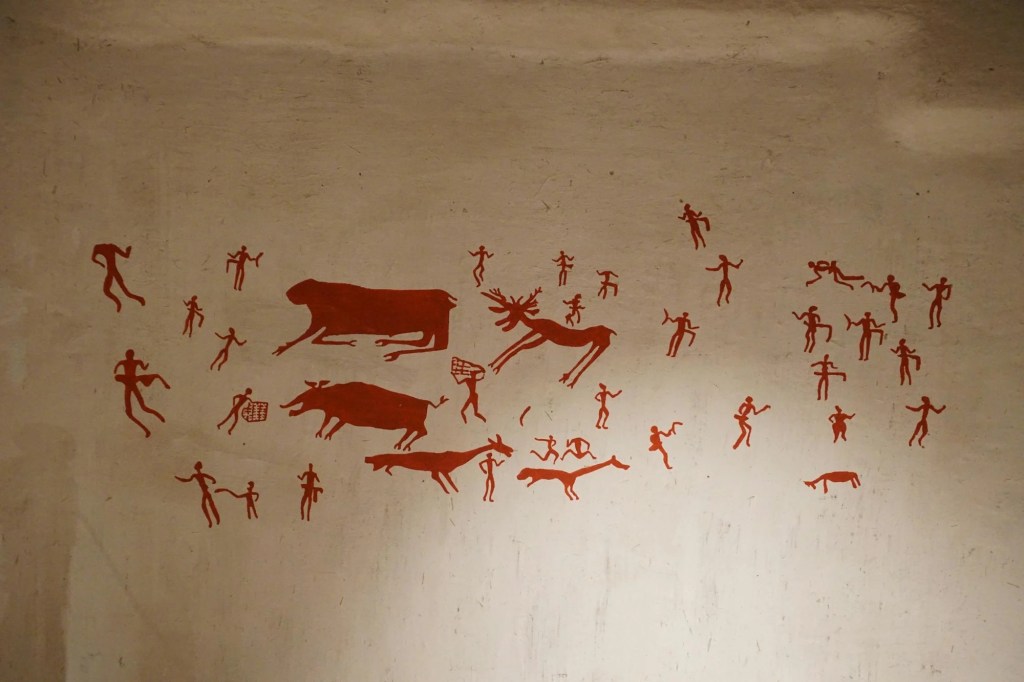
Hunting among the Homo genus was deemed important enough, largely by Homo Sapiens, to commit to art. A common theme in cave art is a large animal being harried by stick figures brandishing various pointy instruments, and it is this scene that hints at how early humans managed to obtain greater quantities of meat.
The ability to hunt animal resources of significantly greater size than themselves is a trait synonymous with hominids. To achieve this, the development of sharpened tools and sophisticated teamwork, manifested through proposed methods such as persistence hunting, were essential. The reward was a (oftencase literal) mammoth caloric bounty rich in micro and macronutrients.
So, the increased social sophistication and physical prowess of Homo species allowed for the acquisition of meat with relatively minor energy expenditure involved. This is not to say that meat occupied the vast majority of diets in this period, only that its intake naturally rose alongside having an easier time of obtaining it. Our current understanding remains that diets remained ‘veg-first’ throughout this period.
Next, in what is surely one of the most catalytic moments in the history of the human diet, is the advent of cooking with controlled fire. It is posited that Homo erectus may boast the earliest evidence for this, dating back 1.8 million years ago. The evidence for this claim is credited to morphological factors such as altered dentition, heavily suggesting a diet of cooked food – meat or otherwise – among erectus individuals.
It is since this culinary touchstone in evolutionary history that we can largely claim humans, and human-like species, are adapted for an omnivorous diet of cooked food. These calories were also obtained through hunter-gathering methods of increased sophistication, with meat occupying a larger share of diets and driving adaptive change in our morphology to reflect this.
These factors explain why we aren’t going against a supposed herbivorous nature as this section began with. Here tools fulfill the role of claws, with our guts and teeth becoming suited to an omnivorous diet in the context of their adaptation to processing cooked meat. Humans are, instead, cannily carnivorous behind our guise of herbivory.
***
Of course, with the advent of animal husbandry some 15,000 years ago Homo sapiens mastered the art of raising meat on-demand as hunter-gathering fell out of style. Even then, animal sources continued to remain a minority party in consumption practices for the vast majority of recorded human history.
The explosion of meat intake – it is safe to say humans have never consumed so much – is in fact a relatively recent phenomenon, with today’s factory farms having amplified availability beyond the dreams of Flintstone et al.
Modern attitudes to meat intake, especially among gym rats and paleo dieters, is likely influenced by our understanding of the most important macronutrient: protein. Our ancestors meanwhile, from A. africanus to Homo erectus and habilis, sought protein on a more instinctual level.
Indeed, protein sources offered a calorie-dense intake to nomadic hominins while maintaining or improving their ability to be mobile and capable. The increased consumption of protein has also been linked to the enlarging of our brains and other physical alterations we can generally be grateful to evolution for.
But what exactly is protein and why is it fuelling a modern diet obsession? Looking back to the relatively lower protein intake, especially that deriving from meat sources, of our ancestors raises the question that surely we are getting too much of the macronutrient nowadays – especially now that our version of hunter-gathering is a trip to Lidl bakery.
Ultimately, understanding its vital role in our bodies ultimately aids us in getting the right amount, from the right sources, and for the right reasons.
Doing Protein Justice
Were you to meet a protein molecule, it would probably feel offended to learn of its reductionist reputation among humans. Most of us understand the principle that protein facilitates muscle tissue growth (hypertrophy), and that plugging it into our bodies is especially useful if the muscle in question has been previously overloaded as a result of resistance exercise.
In actuality, the functions of protein extend far beyond the peak of even the highest bicep; up to a fifth of our body weight is composed from various proteins. Collectively, they fulfil myriad responsibilities from those structural and hormonal in nature, to keeping us safe from viruses via antibodies.
Our hefty bulk of protein is composed from the same 20 ‘essential’ amino acids, despite hundreds of these organic compounds existing in wider nature. When varying combinations of amino acids group together they form a peptide, a chain of which forms a substance known as a polypeptide. Once a polypeptide reaches a certain molecular mass, we have what is, molecularly speaking, a protein.
Interestingly, the complete proteins we ingest are promptly disassembled into their constituent amino acids by enzymes (themselves a protein) through a process known as proteolysis. Following this, they are reassembled in our cells – via the ribosome – into the desired polypeptide chains as required by our body. Biochemistry lesson over.
Of the 20 essential amino acids our bodies are luckily able to naturally synthesise 11 of them, thus tasking our diets to provide the remaining nine. Protein deficiency – including not supplying your protein production line with enough of the nine essential imports – results in fatigue, weakness and general malaise.
Protein deficiency is however vanishingly rare in most modern diets, especially among western meat eaters. A larger problem, in fact, is protein overconsumption which can cause uncomfortable gastrointestinal issues.
Vegetarians are generally more likely to experience a deficiency as they are unable to access some of the most complete protein sources, rich in those amino acids that underpin many of our internal processes. This raises the question as to how Homo Sapiens and our ancestors, without the molecular knowledge of protein, managed to fulfill their amino acid requirements while leading predominantly veg-led diets.
Evidence suggests that vegetarian diets have been, before the beginnings of nutritional science, culturally and instinctually based around obtaining all essential amino acids from a variety of plant sources. It therefore seems even our ancestors knew on a base level about the importance of completing the amino acid checklist, for which we have to thank the hazy wizardry of evolution and the human psyche.
As mentioned earlier, the first evidence of animal husbandry dates to perhaps 13,000 BC. Meanwhile, the first factory farm and the invention of protein powder are 20th century phenomenons. Therefore, of the 300,000 years Homo sapiens have been extant, the vast majority of this period has been spent eating instinctually and striving for our macronutrient requirements in a meat-poor food environment.
As we have seen, trusting in nature’s bounty is indeed a practice traceable back to A. africanus. If it didn’t work, one suspects I wouldn’t be here to write this and you wouldn’t be here to read it.
Selfish History’s Book Recommendation
The Story of the Human Body: Evolution, Health, and Disease by Daniel E. Lieberman
This book outlines the contortion of our physical bodies by the powerful forces of evolution across the period discussed above. Inside, Lieberman details the adaptive effects that changes in diet had on humanlike and human bodies.
He also broadens the scope to include much cultural discussion, including how our social formation and environment has shaped our bodies all the way up to the industrial revolution.

 Selfish History
Leave a comment