
…happy is he whom the Muses love.
– Hesiod, Theogony (c. 700 BCE)
Lend Me Your Ear
In Arles, the autumn of 1888 had only just begun to relent to the baying of winter. Yet, unseasonably, there was a piercing howl to the wind. Those in the vicinity of the ‘Yellow House’ may have discerned voices – men’s voices, deep in dissension – which were the source of the fierce tempest. A concerned, or scared, onlooker, peering through the house’s green shutters, may have even witnessed the height of the storm: one of the men seizing a razor and using it to sever off his own ear. New meaning, then, to giving someone an earful.
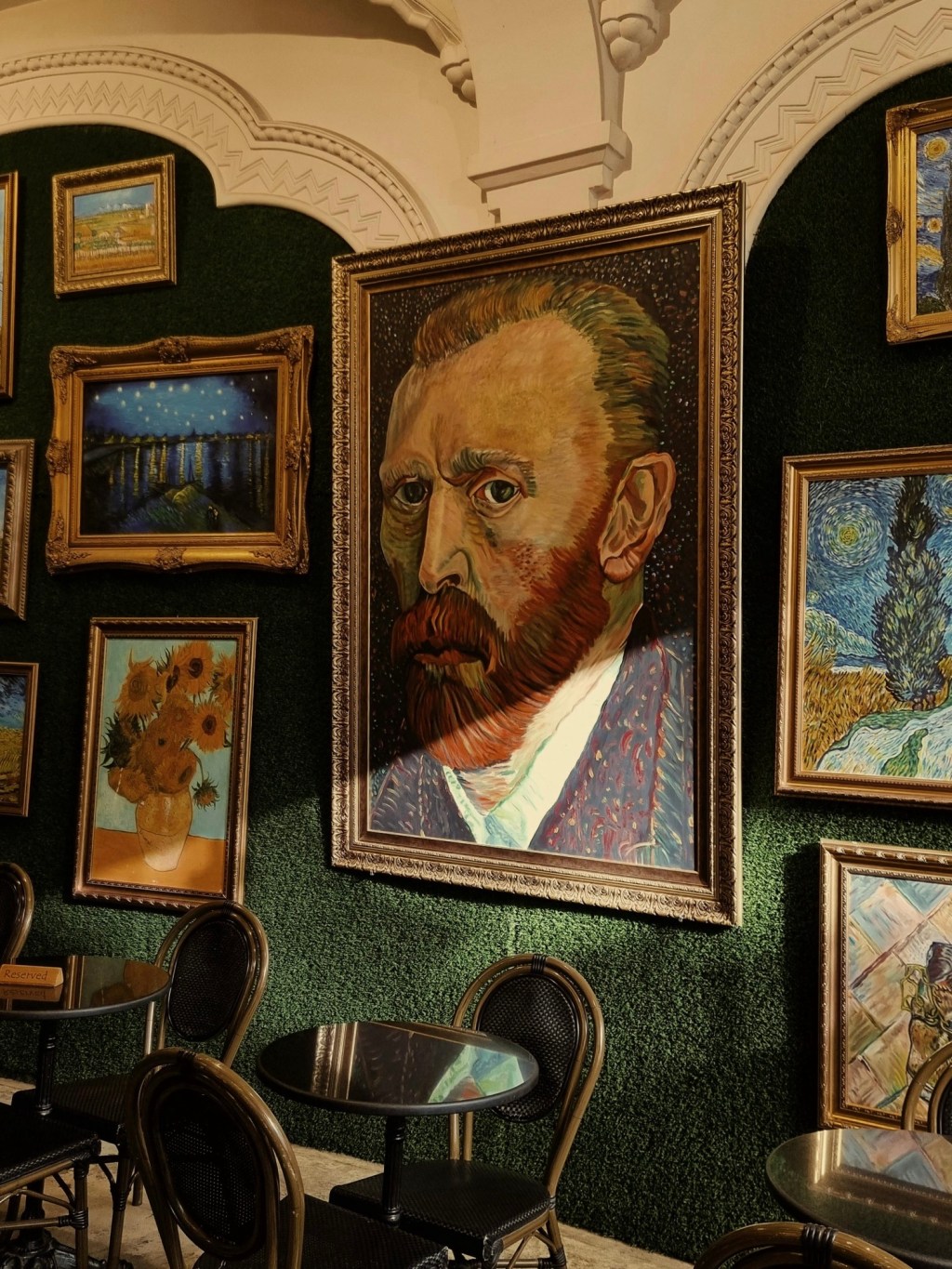
Recovering in hospital, Vincent van Gogh blamed his episode on ‘mental fever’. Yet a psychotic break of sorts, costing him his left ear, would not deter him from painting. Shortly after, behatted in the post-autumn chill, and bearing a bandage, van Gogh painted the prosaically named Self-Portrait with Bandaged Ear.
The 1889-dated painting might be viewed as a vulnerable portrait of a man weighed by episodes of mental distress, sitting small in the shadow of an act of shocking self-mutilation. Simultaneously, however, it is perhaps a symbol of his ambition to continue painting, to strive determinately onwards in spite of the malignant malady which afflicted him. Interpretation aside, it is certainly one of the most famous self-portraits ever created.
Self-Portrait with Bandaged Ear can be understood in the context of this exploration as Vincent’s self-produced legacy to his resilience, and a representation of his personal struggle – crucially composed with his own strokes. Self-portraits are – fundamentally, I would argue – a profound form of self-expression, a curated autobiographical dish representing a slice of one’s identity.
Music To My Ear(s)
It is not, of course, only the fateful events which took place in the Yellow House which have spawned artful self-expression in history; examples of insightfully and reflectively unwinding the myriad knots of one’s life through creative endeavour are prolific and uncountable. Anyone who has written an autobiography, or even kept a personal diary, has voyaged through the inner world, extracting perspectives and experiences to present on canvas in a form of self-representation akin to Van Gogh sporting his bandaged ear.
Poems, paintings, sculptures, graffiti, a fashion-disaster cut together from your childhood bedroom’s tatty curtains. All a form of self-expression, outward sharing of identity, and a tangible legacy closely tied to a particular time or place. Surely one of the most prolific forms that feature in our everyday lives is music.
Indeed, songs of an autobiographical nature have existed for as long as humans could hum a tune; performers and lyricists have long pulled on the thread of their own life experience to create music. Eric Clapton, for example, worked on Tears in Heaven following his four-year-old son’s untimely death. Greenday’s Wake Me Up When September Ends is similarly a reflection on the passing of the frontman’s father.
People also craft music about places which have had a profound impact on them, or otherwise occupy their thoughts and senses. The Clash’s London Calling, serving as a punky example, has taken up a position as an unofficial city anthem of sorts. Likewise, put on any country song and a glowing Tripadvisor review of life in small-town Texas will likely ensue.
The medium of song, then, stands out as a globally popular form of utilising art to reframe personal experience, and stands out as one that resonates with others in a positive way. (No need to book guitar lessons though – the greatest form of artful self-expression is the one which you feel able to do; that is, to pay heed to whichever of the Nine Muses calls loudest to your creative inclinations.)
Continuing to examine self-representation through a musical lens, I pose that what if the place you wish to express and represent in art is a vast, even impersonal landmass? And what if the identity of millions of people is required to be unified under a single songful expression? Well, that would be the undertaking of a country. And, to achieve this mammoth task of artistic expression, you need to craft a flag (out of those nostalgic curtains, perhaps) and choose an anthem.
Anthems: The Melodic Identity Of A Nation
A national anthem, like the Bandaged Ear, is a self-portrait: a self-styled representation of the subject’s values, personality, and struggles overcome. Also like Self-Portrait with Bandaged Ear, national anthems often derive from periods of chaos, crisis and endangerment for the subject. As Van Gogh wore his bandage, many anthems wear the tumultuous, often bloody, history of their nation conspicuously, brandishing it in a defiant showcase of proud legacy.
A handy way to illustrate this is The Star-Spangled Banner.
—
In 1888, Vincent van Gogh survived a malicious mental bombardment to tell the tale in art. In 1814, Fort McHenry survived a bombardment in the more literal definition, and its flag – continuing to fly in brave defiance – inspired a nation’s self-portrait. Examining Star Spangled Banner’s inception will also, hopefully, assist in illuminating the profound impact that can derive from putting your thoughts to paper, canvas, or musical instrument.
The War Of 1812, With Special Guest: 1814
In 1814, the British looked both east across the English Channel and west over the Atlantic Ocean. Their gaze, in both directions, was met with the sharp glare of war. Britain’s dominant right arm, guided by the Duke of Wellington, struck with the greater force, engaged in the sharp-end of the Napoleonic Wars as it was. (In April of that year, it contributed to the temporary deposition of Napoleon following events of the Peninsular War.)
The left, meanwhile, finding itself occupied in the third year of the misleadingly named War of 1812, used the resources that could be spared from Europe in attempting to quell a troublesome America. Tired with attempts to unpick the restrictive stitching of British maritime control, America’s motivation for starting the conflict lay in a fervent, patriotic desire to burst through the seams and wrest back control of its sovereignty.
Which leads us to 13 September 1814, whereupon the strategically important Battle of Baltimore would open its lungs through the siege of the city’s defensive backbone: Fort McHenry. Vice Admiral Sir David Cochrane, a knuckle of Britain’s left hand, was commander of the British naval forces. His task: to root out the privateers operating out of Baltimore and bring about the capitulation – or destruction – of the city. Success relied on Fort McHenry’s downfall – and that of the 1,000 or so defenders squirrelled inside.
So it was that Cochrane set about a 25-hour bombardment of Baltimore’s lynchpin. His conduction of hundreds of guns would produce a cacophony of war, punctuated by the hair-raising highs of over 1,500 bombs or rockets. Cochrane’s song of destruction would be translated into a lyrical poem (itself one man’s personal method of representing his experience through creativity and art) before becoming the defining anthem of a nation.
O Say Can You Hear, That Racket Outside?
Vice-Admiral Cochrane forbade his guests to return to shore. Their knowledge of British strength and intention would bolster Baltimore’s defence and forewarn of the coming bombardment. So it was that Francis Scott Key, one of the men who successfully negotiated a prisoner release with the British, would witness and subsequently write of the Siege of Fort McHenry from a nearby truce ship.
He began his account at the break of day, by the dawn’s early light. Last visible at the Twilight’s last gleaming, the stars and stripes of Fort McHenry’s flag, nervously watched by Francis o’er the ramparts, had survived Cochrane’s overnight bombardment. The lawyer-cum-poet had caught glimpses of it through the night, illuminated by the rockets’ red glare, yet there it stood, defiantly in the morning of 14 September 1814, cementing Fort McHenry as the spiritual centrepoint of the home of the brave.
Francis Scott Key’s lyrical Defence of Fort M’Henry, penned in the direct aftermath of his witness to the Battle of Baltimore’s explosive conclusion, soon adopted a new (and more marketable) name: The Star-Spangled Banner. Its popularity was such that the song, after long fulfilling the role in all but formal embracement, became the national anthem in 1931; thus Key’s creation was confirmed by Congress as the defining musical representation of the United States of America.
Lest we forget, though, that The Star-Spangled Banner, before it transmuted into the US’s national anthem, began life as Francis Scott Key’s personal account of eyewitness events. That is to say that the piece, in essence, is a computation of his intense feelings of worry, anguish, relief, and pride that he chose to represent – to reflectively explore and process – through the medium of poetic writing. Yes he disseminated it, but only to share these intense personal feelings with others. Therefore, we are looking at what boils down to an example of artistic self-expression: the processing of a traumatic experience – as Van Gogh did with Bandaged Ear – through demystifying one’s feelings around it via creativity.
We will go one further. An artistic (if suitably insufferable) interpretation of Van Gogh’s self-portrait is that, in his own way, he represents that, like McHenry’s, his flag was still waving (and I don’t mean that his dressings were flapping in the wind). It is a link which brings us to the final discussion.
Final Musings
Two examples of artful self-expression have been discussed above: Vincent van Gogh’s Self-Portrait with Bandaged Ear, a painting, and Francis Scott Key’s Defence of Fort M’Henry, a poem. Both, as we know, went on to become something great, a shining example of the creator’s legacy. Both, though, are fundamentally personal legacies to individual moments in the lives of their creators; their worldwide fame is, I would argue, a second life of secondary importance. That these art pieces have become so celebrated, so grand in scope, does not detract from the fact that each served its intended function prior to becoming popular and renowned.
The creation of each represents a moment in time for the creator, as well as a myriad of symbolism: tangible proof to oneself of troubles overcome, a way to reflect upon a traumatic experience, pride in a positive outcome, a physical warning against previous mistakes, a representation of personal values, a personally guided legacy to a moment in time. Our own examples, then, need not emulate Van Gogh in popularity, or gather nations under its message like Scott – they are no less personally profound to us in lack of adopting a second life, just as the above examples’ subsequent success is peripheral to the personal purpose of their creation.
When, then, we are faced with our own bandaged ear or against-all-odds flying flag, a fine way to process, commemorate, or recover from the moment is to put it into literature, brushstrokes, sculpture – whichever manner you wish. In doing so, the impact upon oneself of the concerned experience is unravelled and revealed to be plucked apart, to be dissected into lessons learned and wounds healed.
Utilising creativity as a means of self-expression is to craft a legacy to life events, a snapshot of feelings from a particular place and time. Some, as we have seen, go on to seemingly higher callings, but this is not the barometer of success. All immediately justify their own existence in ways inherent to the individual who created them.
—
They chant the race of men and strong giants, and gladden the heart of Zeus within Olympus, – the Olympian Muses, daughters of Zeus the aegis-holder.
– Hesoid, Theogony (c. 700 BCE)

 Selfish History
Leave a comment